Showing posts with label World Development. Show all posts

2022/03/01

47. IDER-22-1 to 22-4. CO2 Total Emissions in the World 1970-2015 and other international development reports

Source: Guisan and Exposito(2020). Applied Econometrics and International Development, Vol.20-2 


    IDER 22. International Development Reports of year 2022

Final version published in Guisán(2025b), EcoDev 128. Initial version published in Entry 47 of https://euroamericanassociation.blogspot.com

IDER 22-1.CO2 Total Emissions in the World 1970-2015

It includes some contents  of Total CO2 Emissions, Population and CO2 per capita,  presented in the articles:  

Guisan(2020) in AEID 20-1.

Guisan and Exposito (2020), AEID 20-1.  

The article by Guisan and Exposito(2020) shows that 87% of increase in Total World CO2 Emissions, for the period 1970-2015, was due to Population Growth while the World average of CO2 Emissions per capita explains only 13% of the total increase. Besides it is important to have into account the effects of Wild Fires, because excluding the effect of those fires, the average per capita diminished from 4.23 to 4.0 Tm per inhabitant.

 The empirical evidence shows that it is important to foster international cooperation for increase financial help to education in low income countries, because it is the best way to get sustainable development with moderation of high rates of population growth and improvement of economic development, health assistance and poverty eradication.

Under the Hypothesis of Population growth for the period 2025-2030, at the article by Guisan and Exposito are the following ones: 1) to reach 8.249 Bn people (the most moderated), 2) to reach 8733 millions (the highest of the 3 hypotheses of the article), there are important differences in development and environmental pollution. Under the hypotheses of increase of education and moderation of average fertility rates, there are more possibilities for poverty eradication and increase of real income per capita, health services and quality of life, as well as a moderation in the increase of Total CO2 and and other environmental problems.

The main industrialized countries of the European Union have diminished, not only in per capita terms, but also CO2 Total Emissions, given is moderate rate of population growth. Total Emissions of CO2 have diminished by 475 million Tms in a group of 6 industrialized European Countries (France, Germany, Italy, Switzerland, United Kingdom and Spain), for the period 1970-2015.

More information

EPA. United States Environement Protection. Agency. Gobal Greenhouse Gas Emissions Data.

IDER 22-2. Industrial Production by Sector in France, Germany, Spain and the United States, in year 2015.

A telephon version, of the Website sidebar: 

2022/01/18

46. IDER 21-1 to 21-4. Education, Production and Quality of Life in 164 countries, 1995-2019 and other international development seports


     World Development Reports published by the Euro-American Association of Economic Development Studies in year 2022

Entry 47 by Maria-Carmen Guisan, Professor of Econometrics, Spain

Provisional version 25-12-2022. Last update 11th September 2024.. The final version is scheduled to be published in EcoDev 128 in year 2025 (see footnote below)


IDER

INTERNATIONAL DEVELOPMENT REPORTS year 2021

2021-4

Wages, Productivity and Quality of Life in France, Germany, Spain and the United States,  1960-2019 . Related article in Guisan(2021) in RSES (4)

2021-3

Industry, Education and Development in 53 African Countries, 1995-2019  (3)

2021-1

A Comparison of India, China and OECD Countries for 1950-2020  (2)

2021-1

Educarion and Development of 164 Countries for 1995-2019

The final versions of IDER reports of year 2021 are scheduled to be published in Guisan(2025 c) EcoDev 127, downloadable at Ideas.Repec.


Related articles in AEID and RSES:


(1) World Development For 1995-2020: Econometric Relationships Of Human Capital, Development, Quality Of Government And Life Satisfaction In 164 Countries, Guisan, M.C   Abstract and article in AEID 21-1

(2) Employment by Sector and Development in India for 1950-2020 and International Compa-risons with China and OECD Countries, Guisan, M.C.Abstract and article in AEID 21-1.


(3) Industry, Education, Development and Quality Of Life In 53 African Countries, 1995-2020, Guisan, M.C., Exposito, P.  Abstract


(4) Spanish and European Report 2021: Wages, Productivity, Quality of Public Sector and Citizens Satisfaction, Guisan M.C. (Abstract and article in English) (Article in Spanish)


 Initial versions of IDER 21-1 to 21-4 (year 2021)


             IDER 2021-1: World Development 1995-2019

 Evolution in 24 years:  Real production per capita increase in 6249 Dollars (at 2017 prices) in a period of 24 years (from 1995 to 2019), what implies an average of 260 Euros per year, but in the 2 groups of poorest countries the increase was very low with only 20 Euros per year in group 1). 


      1) Education and Development: Usually Education is the variable with the highest impact on economic development and quaality of life. The indicator Tyr10 is "Total years of schooling of adult population (+25 years old) in year 2010. The value varied between a low average of 3.38 years of Schooling in group 1 (lowest level of economic development)  to 11,66 in group 9 (highest level of economic development). World average was 8.09.


      2) Average Fertility rate: As seen in the econometric model of Guisan, Aguayo and Exposito (2021) (journal AEID Vol. 1-1), there is an important impact of Education in the moderation of average fertility rates. In table 1 we may notice that countries with the lowest levels of Schooling have high average Fertility rates (4.82 children per woman in group 1) while countries with high educational levels have moderate average Fertility rates (1.53 children per women in group 9). 


        3) Indicators of Quality of Life in a scale 0 (minimum) to 10 (maximum). 

Indicator X1=Happiness varies from an average of 4.27 in group 1 to 7.07 in group 9, usually increasing with real income, health care access, working conditions, and other variables related with socio-economic development. 

Indicator X2=Government Quality (calculated in the scale 0 to 10 from the World Bank data of Voice of citizens) varies from 3.12 in group 1 to 7.07 in grourp 9, usually increasin with socio-economic development.

Indicators X3 and X4 (X3=degree of conflict, X4=degree of peace). The average value of X3 varies between 6.00 in group 1 to 3.70, with many types of conflicts usually decreasing with socio-economic development. The average value of X4 varies between 4.00 in group 1 to 6.30 in group 9, usually increasing with socio-economic development. 


Indicator XM is the mean of the indicators X1, X2 and X4. The average value varies between 3.79 in group 1 to 7.20 in group 9, usually increasing with socio-economic development. 


Other contents of the Development Report: The main objetive of this report is to foster international cooperation in order to increase Schooling, Investment, Production per head and Quality of Life in the World, particularly in countries with the lowest levels.


We highlight the following table from the Report published in  AEID 2021 by Guisan, M.C., which is free downloadable by clicking on "Abstract":


 Source: Guisan , M.C. (2021). World Development For 1995-2020: Econometric Relationships of Human Capital, Development, Quality Of Government and Life Satisfaction In 164 Countries, Guisan, M.C   Abstract

                  We may notice a positve evolution of Production per head,  in the 9 groups of countries of the table for the period 1995-2019, but with great differences among the lowest and the highest values, both in 1995 and 2019. Countries of groups 1 to 5 were below World average in year 2019. 

            Countries with the highest levels of Education, with average years of School Atteinment of adult population higher than 10 years, are over the World average of Production per capita and also have good average values in other indicators: Between 6.07 and 7.07  average points for  "Happiness"; average between 5.94 and 8.24 points in the indicator of Quality of Government (given by Voice of Citizens), between 5.47 and 6.30 for the indicator of Peace, and between 5.83 and 7.20 as average values of XM (being XM the meand of the indicators X1 (Happiness), X2 (Government Quality) and X4 (Peace).

IDER 21-2.

The following graphs show the increase of Production per head and Productivity per worker in India, China and OECD countries, for the period 1951-2000. 
        (Increase in Dollars at 1990 prices and purchasing parities)
       Elaborated by Guisan((2021) in AEID (2021) with data from Maddison and World Bank.

     The report and the related article published in AEID 21-1 expalin the important impact of Education and Industry on the evolution of Production per head and Productivity per workder.

IDER 21.3. Africa

The average production per capita in 35 African countries was below World average for the period 1995-2019. The average real value of Gross Domestic Product per capita in Africa evolved  from 3849 in year 1995 to 6086 in 2019, while World average evolved from 9886 in 1995 to 16135 in year 2019. 

The average years of schooling in Africa (4.78 years of schooling of adult population) was clearly below the World average (8.09) in year 2010). The empirical evidence show the positive impact that Education usually has in the moderation of excessively high fertility rates and in the increase of savings per capita, investment per capita and industrial production per capita, development and quality of life.

The comparison of Africa average with World average shows, in year 2019, a Fertility rate of 4.10 in Africa and 2.40 in the World. The indicators of quality of life X1(Life satisfaction), X2 (Quality of Government: Voice of Citizens) and X4 (Peace) of Africa were below World averages. 
X1= 4.28 in Africa and 5.35 in the World
X2=3.50 in Africa and 5.0 in the World
X4=4.37 in Africa and 4.80 in the World

The comparison of real value-added per capita by sector, accordingly to the World Bank data, shows the following differences in year 2017:
QHA= Agriculture and Fishing: 592 in Africa, 766 in the World
QHI= Industry and Building: 1211 in Africa, 4771 in the World
QHS= Services: 2411 in Africa and 12149 in the World

Africal countries with the highest levels of QHI are usually those with with the highest levels of QHS and real GDP per capita.
Education contributes to favor savings and credits per capita and to increase industrial production per capita.

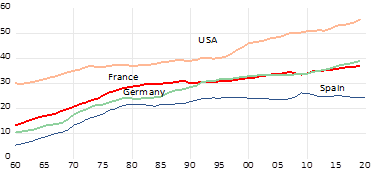
IDER 21-4. Wages, Productivity and Industry in France, Germany, Spain and the United States. International Report 1960-2019.

This graph shos the evolution of average real wages, expressed in thousand Dollars per worker at 2000 prices and exchange rates. Wages are calculated as the ratio between Compensation of Employes and number of Employees, and thus it includes social costs. that firms and worker pay, linked to the wages.

   Graph: Real average wage in 4 countries for 1960-2019
     (Dollars per employee at 2000 prices and exchange rates=

Source: Elaborated by Guisan from OECD statistics

    Graph: Real Mean Productivity of labour (PM) in 4 countries
     for 1960-2019 (Dollars per employee at 2000 prices and parities)

       Source: Elaborated by M.C. Guisan(2021) from OECD statistics


Spain has the lowest level of average real wage, in this group of 4 countries, because it has also the lowest level in productivity per worker. It does not imply that the Spanish workers are not efficient, but that the country has the lowest level of industrial production per inhabitant. The empirical evidence of international studies confirm the Kaldor´s views that the increase of industrial production and productivity has positive effects on the productivity of other sectors and on real Gross Domestic Product per capita. 
Spain is also the country of the group with lower resources devoted to Rsearch and Development, in this group.
The United States has kept, for all the period 1960-2020. a great advantage in comparison with these 3 European countries regarding real wages, producitiviy and development.


 A telephon version, of the Website sidebar: 


2019/12/03

36.Selected Readings: Articles of AEID on World Development and other International Comparisons, 2001-2024


 This Entry includes links to Articles pubished in Applied Econometrics and International development on international comparisons, of countries from different geographical areas. 
Readers may see other Entries of this Blog for other geographical areas: 
                                        
                               Updated 31st December of 2024

Table 6. Articles on World Development and International Comparisons in year 2024.

AEID Volume 24-2 (year 2024)

Pathways from Poverty: The correlates and probabilities of penury life in 131 countries, 1980-2022,  Christopher E.S. WARBURTON Abstract

IDER 2021-2024: A Summary of 16 Internacional Development Reports (America, Europe, India, China, Africa, Eurasia and other Areas), 1990-2020, Maria-Carmen GUISAN  Abstract

AEID Volume 24-1 (year 2024)

Economic Literature on Financial Vulnerability of Low-IncomeHouseholds: Review and Future Research Agenda, FERNÁNDEZ-LÓPEZ, Sara ÁLVAREZ-ESPIÑO, Marcos ,REY-ARES, Lucía  Abstract

Bibliometric Analysis of Financial Distress Prediction: Exploring Research Trends and AdvancementsSoumya Ranjan SETHI Dushyant Ashok MAHADIK  Abstract 

Development and Financial Indicators in 164 countries: Analysis of causality for 2021. GUISAN, Maria-Carmen Abstract

              
                     Updated 10th Agust of 2023

Table 5. Articles of AEID on International comparisons published for 2021-2023

Year 2023


Current External Challenges to the Economic Expansion of Emerging Markets:  An Analysis of Chile, Colombia, Mexico, Turkey, Ghana and India for 2006-2021, Juan Carlos MORENO-BRID, Lorenzo NALIN, Edgar PEREZ-MEDINA Abstract

How Does Intra-State Violence Affect Nations´Trade Flows? A Quantitative Assessment on South Bond market development as a source of financing infrastructure projects:  A comparison of India, Russia and other countries, 2010-2020, Arnaud NZENGUET NZENGUET, Abssract

Selected books on World Development: Education, Freedom, Political Stability, Peace and Qualtity of Life: E-books on World Development  for the periods 1960-2000 and 2001-2023, Maria-Carmen GUISAN, Abstract

Panel Data Analysis of the Human Capital Index and Income Inequality: A Panel of 203 Countries for the Period 1988-2018, Brandon PARSONS  Abstract

Per Capita Income Convergence and Divergence of Selected OECD Countries to and from the US: A Reappraisal for the period 1900-2018, László KÓNYA  Abstract

Are shocks to electricity consumption permanent or transitory? Evidence from a panel stationarity test with gradual structural breaks for 25 OECD countries, Jamal G. HUSEIN; S. Murat KARA   Abstract

 Year 2022

 Income Inequality, the World Values Survey, and the Interaction of Cultural Dimensions, Edwards, J. A., Romero, A., Naanwaab, C. Abstract

Life Satisfaction,  Income, Security And Environment:  An Interregional Econometric Model of 372 Regions From  Europe, America, Asia And Oceania In Year 2016, Guisan, M.C. Abstract

 Impact Of Economic And Financial Openness On Domestic Inequality In Developing And Emerging Countries: A Panel Data Study Of 11 Countries For 1980-2016, El Bouhadi, A., Ouahid, D., Elkhider, A. Abstract

 The Impact Of Digital Financial Inclusion On Socio-Economic Development In Low-Income CountriesYakubi, Y.A.Y., Basuki, B., Purwono, R. Abstract

 Economic Growth And Military Expenditure In Developing Countris During  Covid-19 Pandemic, Susilo, A.K., Sari, D.W., Putra, I. N., Pratiwi, N.A.  Abstract

Political Stability, Peace And Economic Development In 164 Countries, 2010-2020, Guisan, M.C.  Abstract

 Year 2021

Export Led Growth Via Intra-Regional Trading An Econometric Analysis Of ASEAN, EU, NAFTA, MERCOSUR and COMESA, Haxman, S., Omar, K., Halimb, A. Samsudin, M.S.  Abstract

World Development For 1995-2020: Econometric Relationships Of Human Capital, Development, Quality Of Government And Life Satisfaction In 164 Countries, Guisan, M.C   Abstract

 Secular Stagnation and the Negative Interest Rate Conundrum: International analysis of the Period 2010-2019, Warburton, Christopher E.S. Abstract


   Articles of AEID on international comparisons published for 2001-2020. Tables 1 to 4 include articles for quinquenial periods (for 2001-2005, 2006-2010. 2011,2015,2016-2020) 

Table 4. Articles o International Comparisons published in AEID for the period 2016-2020.

Year

Article

2020

The Acquisition of Human Capital and Economic Growth: An international survey, Warburton, C.E.S.    Abstract                

Financial development-poverty reduction nexus in BRICS: A panel data analysis approach, Tsaurai, K. Abstract

National Wealth Structure of the Countries of the World and Economic Development, 2000-2014, Guzev, M.M., Ledeneva, M.V., Polkovnikov, A.A. Abstract

Saving-Investment-Current Accounts Dynamics, Financial Crisis and Economic Growth: Some Empirical Results, AMIRKHALKHALI,S., DAR, A. Abstract

Determinants of inward foreign direct investment: Comparison across different country groups, Das, M. Abstract

Core-periphery relations in the international mergers and acquisitions network, Galaso, P., Sanchez-Diez, A. Abstract

Oil Price And Economic Growth Of Oil-Importing Countries: A Review Of International Literature, Akinsola, M.O, Odhiambo, N.M. Abstract

CO2 Total Emissions in the World, 1970-2015: Relationship with Economic Development and Population Growth; Guisan, M.C., Exposito

2019

FDI, Growth and Level of Development: Analysis of 76 countries for the period 1980-2010, Grubaugh, S.G. Abstract

The Duration of Trade Agreement Negotiations: Analysis of 80 cases for 1980-2011, Arroyo, L., Castillo-Ponce, Ramon, A. Abstract

Trade Openness, Factor Productivity, and Economic Growth: Recent Evidence from OECD Countries,  AmirKhalkhali, S.; Dar, A.Abstract

Debt Relief and Good Governance: New Evidence of Developing Countries for the period 1990-2013, Freytag, A., Schmied, J.Abstract

2018

Positive Time Preference and Environmental Degradation: The effects of population growth and economic activity on intergenerational equity, Christopher E.S. Warburton  Abstract

Determinants of the percentage of savings in emerging markets: A panel data analysis approach, 1995-2015, K. Tsaurai. Abstract

Public Debt Service And Economic Growth: A Survey Of International LiteratureSAUNGWEME, T., ODHIAMBO, N.M.  Abstract 

Drivers Of Growth In Fast Emerging Economies: A Dynamic Instrumental Quantile Approach To Real Output And Its Rates Of Growth In BRICS And MINT Countries, 2001-2011, Asongu, S., Odhiambo, N.Abstract

Public Consumption and Government Expenditure in 6 OECD Countries and Their Effect IN Macroeconometric Models of Disequilibrium, 1970-2016, Guisan, M.C.  Abstract

2017

Fiscal Policy, Total Factor Productivity and Economic Growth in Advanced Economies,    Dar, A., AmirKhalkhali, S. Abstract

Key Determinants of Civil Liberty: a Spatial Analysis of 175 Countries in the year 2010, Chasco, C.,  Lacalle-Calderon, M. , Alfonso-Gil, J. Abstract

Market Efficiency, Sovereign Debt Restructuring And Credit Ratings In Developing Countries, Robinson, C.J., Bangwayo-Skeete, F. Abstract

Effect of FDI on real per capita GDP Growth. A Rolling Window Panel Analysis of 60 countries, 1982-2011, Edwards, J.A., Naanwaab, C.B.,  Alfredo A. Romero, A.A.  Abstract

2016

The Bottom Twenty: An Analysis Of Income Inequality In High Income And Developing Countries, 1990-2010, by Christopher E.S. WARBURTON Abstract

Interaction Between Capital Flows And Current Account: A Dynamic Panel Causality Analysis Of 19 Emerging Market Economies For The Period 1980 To 2009, by A.Yasemin YALTA & Bahar BAYRAKTAR-SAGLAM Abstract

Public Debt, Saving-Investment-Current Account Dynamics, and Capital Mobility in OECD countries, 1999-2013S. AmirKhalkhali, A. Dar Abstract

Financial Development and Economic Growth in advanced and developing economies over the period 1975–2009 Doumbia, D. Abstract  

Aid-for-Trade and Export Performance of Developing Countries, Ghimire, S., Mukherjee, D., Alvi, E. Abstract  

The International Law and Economics of Coercive Diplomacy: Macroeconomic Effects and Empirical FindingsC E.S. Warburton Abstract 


Table 3. Articles on International Comparisons published in AEID for the period 2006-2010.

Year

Articles

2015

Saving-investment Dynamics and capital Mobility in the BRICS, Behera, S.R. Abstract

Corruption centralization, investments, and growth, Nuryyev, G., Hickson, C. Abstract

Reciprocity in bilateral trade flows: An empirical analysis for trade between Australia and Latin American countries, Gonzslez, G.H., Esposto, A.S., Valentina N. Viego, V.N. Abstract

2014

Time Dynamics of Stabilization Theories and Responses to Debt and Financial Crises: An Analysis of Mexico, Argentina, Nigeria and Ghana, 1960-2011, Warburton, C.E.S. Abstract

Absorptive Capacity Compared: Evidence from Sectoral Data of OECD, Asian and Latin American countries, Montinari, L., Rochlitz, M. Abstract

The Effect of Labor Composition Index on Economic Development: Analysis of 18 countries for the period 1990-2010, Ozerkek, Y.  Abstract

New Prospects of Economic Growth in Context of Underdevelopment Whirlpools Phenomena,Popkova, E.G.  Abstract  

On The Impact Of Public Debt On Economic Growth In 23 Countries, 1996-2007, Dar, A.A., Amirkhalkhali, S.A. Abstract


2013

History of the Global Business Environment in the Polycyclic Conceptual Framework and Estimation of Econometric Models of World Development 1950-2010, Kokodey, T.A.  Abstract

Macro-Econometric Models of Supply and Demand: Industry, Trade and Wages in 6 Countries, 1960-2012 , Guisan, M.C.  Abstract  

The EFA Development Index and Per Capita GDP: A Quantile Regression Approach in A Cross-Section of 123 Countries for Year 2007, Islam, S.  Abstract

Is There Feed-Back Between Economic Freedom and Economic Growth: A Comparative Granger-Causality Test Based On Quartiles, Webster, A.L. Abstract

2012

A Cross-national Panel Study of Devaluations on Disaggregated Export Sectors: A Case for Sector Specific Policies, Cantavella-Jordá, M., Amin Gutierrez de Piñeres, S. Abstract  

ISI and New Industrial Conditions in Latin America and Africa, Warburton, C.E.S.  Abstract

On Explaining Inter-Country Differences in Economic Growth Rates of OECD countries for 1996-2008: Does Regulatory Quality Matter?, AmirKhalkhali, S., Dar, A.A. Abstract  

Microfinance Social Performance:A Global Empirical Study, Marr, A., Awaworyi, S. Abstract

Development Aid, Corruption, and the Happiness of Nations: Analysis of 118 countries, 1996-2009, Arvin, M.B., Lew, B., Abstract

Fiscal Deficits, Current Deficits and Investment: A Panel Causality Framework of 20 OECD countries, Miteza, I. Abstract

Civil Liberties and Access to Water: Analysis of 140 countries, Biser, J.J, Edwards, J.A. Abstract

Crisis Exacerbated Fiscal Deficits and Possible Impact on FDI Flows: An Empirical Analysis of Emerging Europe and India, Bose, S., Jha, S. Abstract


2011

Technology Gap, Catching-up and Outward Orientation: Analysis of 63 countries,  Iyer, K. Abstract

On the Impact of Openness and Regulatory Quality on Saving- Investment Dynamics in Emerging Economies, Dar, A., Amirkhalkhali, S. Abstract

Effects of Health Systems and Socioeconomic Factors in Reducing Child Mortality in Developing Countries: Empirical Results from System Generalised Method of Moments, Kamiya, Y. Abstract

AEID.Vol. 11-1. January-June of 2011

Health Care Efficiency Across Countries: A Stochastic Frontier Analysis, Ogloblin, C. Abstract

Financial Globalization and Inflation In Developing Countries: A Reappraisal, Miles, W. Abstract


Table 2. Articles o International Comparisons published in AEID for the period 2006-2010.
Cancelo, M.T. (2010)
The Relationship between CO2 and Sulphur Emissions with Income: An Alternative Explanation to The Environmental Kuznets Curve Hypothesis. Abstract
Gimenez, G., Sanau, J.
(2009)
Investment, Human Capital and Institutions: A Multi-equational Approach for the Study of Economic Growth, 1985-2000. Abstract  

Karras, G. (2008)
Growth and Convergence, 1950-2003. What Can We Learn From the Solow Model?  Abstract         
Bildirici, M., Sunal, S. (2006)
Economic Determinants of Development in World Economy, 1920-2005. An Analysis of 165 Countries.
Guisan, M.C.,
Neira, I. (2006)
Direct and Indirect Effects of Human Capital on World Development, 1960-2004.     Abstract 

Table 1. Articles on International Comparisons) published in AEID for the period 2001-2005.
Auhtors
Article
Bildirici, M., Orcan, M.,
Sunal, S., Aykaç, E. (2005)
Determinants of Human Capital Theory, Growth and Brain Drain: An Econometric Analysis for 77 CountriesAbstract 

Valadkhani, A. (2005)
Macroeconometric Modelling: Approaches and Experiences in Development Countries. Abstract 
Sobhee, S.K.,
Joysuree, V. (2004)
The Implications of Openness for  WAGNER’S Law. An International Comparison of 20 Countries, 1971-2000. Abstract  
Konya, L. (2004)
Export-Led Growth, Growth-Driven Export, Both or None? Granger Causality Analysis on OECD Countries.  Abstract

Cook, S. (2004)
On the Detection of Business Cycles Asymmetry in 22 Countries, 1870-1994. Abstract 

Guisan, M.C.,
Exposito, P. (2004)
2.- Comparative Studies of OECD Countries: Econometric Models and Evolution of Agrarian and non Agrarian Employment in OECD Countries, 1950-2000, Abstract 
Guisan, M.C.,
Arranz, M. (2003)
Econometric Models of Private and Public Health Expenditure in OECD countries, 1970-96.  Abstract

Karras, G. (2003)
Trade Openness and Economic Growth: Can We Estimate the Precise Effect?. Abstract 
Guisan, M.C., Cancelo, M.T.
(2002)
Econometric Models of Foreign Trade in OECD Countries. Abstract y article
Cancelo, M.T., Guisan, M.C.,
Frias, I. (2001)
Supply and Demand on Manufacturing Output in OECD countries: Econometric Models and Specification test  Abstract y article  
Guisan, M.C. (2001)
Causality and Cointegration  between Consumption and GDP in 25 OECD countries: Limitations of Cointegration Approach.   Abstract y article
Guisan, M.C.,
Aguayo, E.
Exposito, P. (2001)
Economic growth and cycles: Cross-country models of Education, Industry and Fertility and International Comparisons. Abstract y article
Guisan, M.C.,
Aguayo, E.,
Exposito, P. (2001)
Education and World Development in 1900-1999:
A General View and Challenges for the Near Future.  Abstract
https://ideas.repec.org/a/eaa/aeinde/v1y2001i1_4.html

About  the journals AEID and RSES, publisdhed by the Euro-American Association of Economic Development Studies (EAAEDS) for  the period 2001-2020.

The Founder Editor is Professor Maria-Carmen Guisan, who has been Director of the Master of International Sectoral Economics at the University of Santiago de Compostela (Spain). She is an economist included among Top 50 authors by downloads (out of more than 50000 authors) at the international ranking of Ideas.Repec.
The Honorary President of the Advisory Board has been, Professor Lawrence R.Klein, from the Wharton School of the University of Pennsylvania (USA) and Nobel Prize of Economics.
The index of all articles, with free access is included at the following address: https://ideas.repec.org/s/eaa/aeinde.html

Applied Econometrics and International Develpment (AEID): It is an academic journal included in SCOPUS of Elsevier, Ideas.Repec, Econ-Lit of the American Economic Association, and other selected indexes of Economics research. Published by the Euro-American Association of Economic Development Studies, includes sections devoted to World Development, Europe and Eurasia, America, Africa and Middle-East, Asia and Pacific. 

More information about AEIDEditorial Board and inclusion en selected journals Indexes: See Entry 41 of this Blog.

Regional and Sectoral Economic Studies (RSES): It is also a prestigious and interesting journal, included in selected indexes: SCOPUS of Elservier, IBSS, Econ-Lit, Ideas-Repec, Selected Catalogue of Latindex, etc.  It also has reached academic recognition  and high positions in the number of downloadas per item at Ideas.Repec.

More Information about the publications of the Euro-American Association of Economic Development Studies (EAAEDS), at Entry 63 of this Blog

All he Entries of this Blog at